Industry Source
Researchers Train A.I. to Mimic Lighting Simulations
Published: August 5, 2026
View original sourceNews Summary
Inside Lighting reported on an August 2026 LEUKOS paper that explores whether machine learning can approximate electric-lighting simulation results fast enough to help early layout decisions. The researchers built a dataset from 9,000 ClimateStudio simulations, covering varied room layouts, luminaire types and surface reflectances, then trained several models to predict illuminance at sensor points.
The strongest model, a CatBoost regressor, achieved an average R-squared value of 0.92 for point-by-point predictions. Inside Lighting emphasizes that the result should be understood as a fast first-pass calculator rather than a replacement for professional simulation, because the model was trained against ClimateStudio output and its layout-level accuracy varied substantially across fixture and material combinations.
The report also notes current limits that matter to working specifiers. The paper did not evaluate glare, vertical illuminance or daylight interaction, and the model struggled in some higher-output and mid-reflectance conditions. Its potential value is therefore speed: helping teams filter concepts before investing time in a full AGi32, Radiance, DIALux or ClimateStudio workflow.
- Inside Lighting published the report on August 5, 2026.
- The article covers a LEUKOS paper by researchers from the University of Texas at San Antonio and Shahid Beheshti University.
- The researchers trained a CatBoost model on 9,000 ClimateStudio simulations and 684,000 sensor readings.
- The model reached an average R-squared value of 0.92 for point-by-point predictions, while layout-level accuracy varied widely and the paper did not evaluate glare or daylight interaction.
FLOSEEK Interpretation
FLOSEEK reads this as a sign that lighting specification is moving toward faster concept testing and more data-supported conversations. For B2B project buyers, early-stage decisions often happen before every ceiling detail is fixed, so tools that quickly compare layouts may help narrow fixture spacing, output direction and zone intent before final engineering.
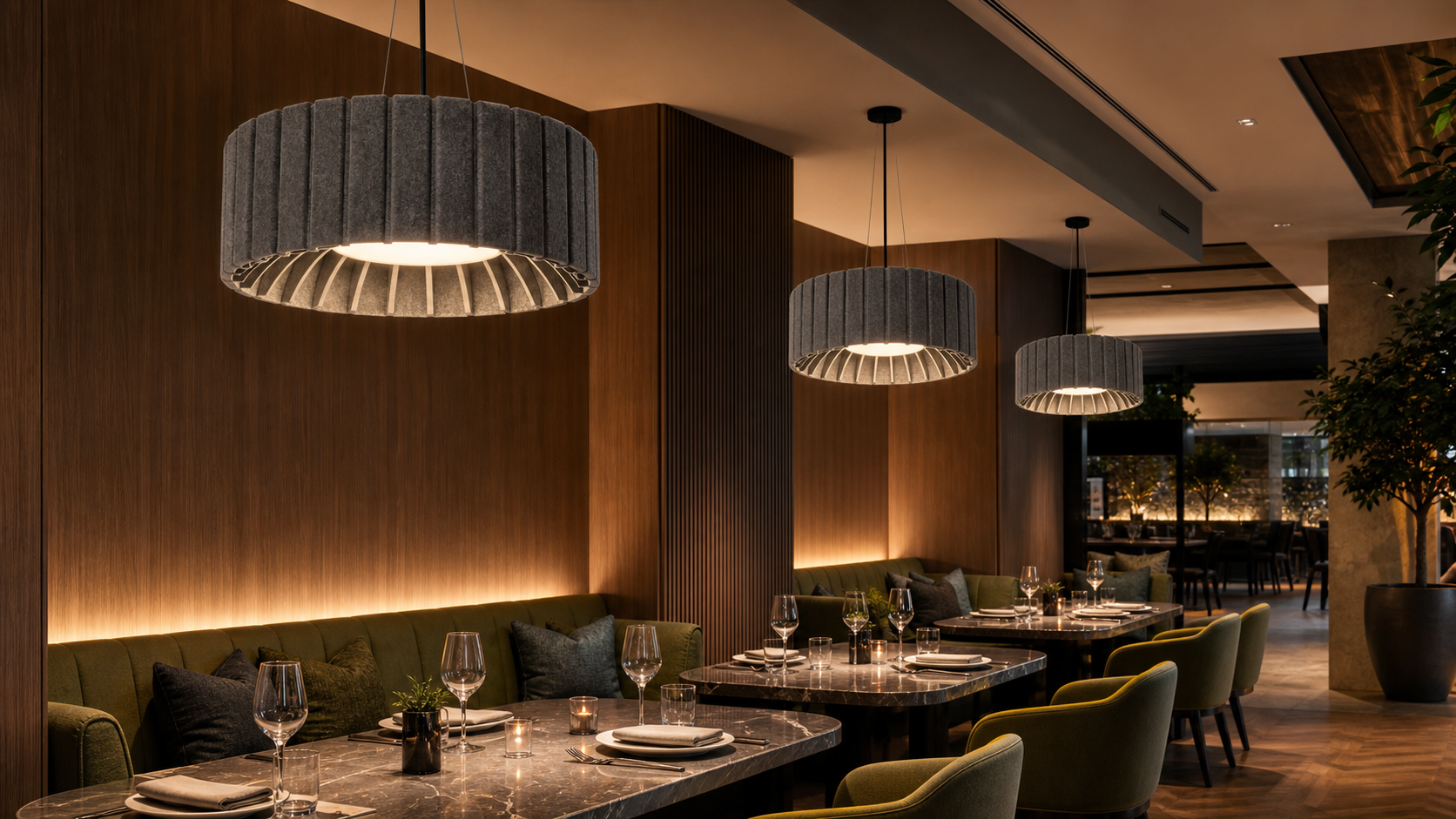
For acoustic lighting, the important point is not that A.I. replaces design judgment. PET felt fixtures still require attention to glare, CCT, suspension height, felt color, acoustic surface area, ceiling services and room use. But faster lighting feedback can make it easier to evaluate acoustic luminaires as part of the first layout conversation instead of adding them late.
Impact on Acoustic Lighting
For acoustic lighting suppliers, this kind of research raises buyer expectations for responsive specification support. Teams may increasingly ask suppliers to provide quick layout guidance, typical spacing, light-output options, control recommendations and clear limits before a formal lighting designer completes the final model.
For B2B project buyers, the impact is a better briefing process. When requesting acoustic linear lights or pendants, teams should share room dimensions, ceiling height, target illuminance, working plane, surface finishes, CCT preference, glare concerns and acoustic goals so early layout studies can be useful without pretending to be final verification.
Apply This Trend
Need acoustic lighting options for a current project?
Send drawings, room type, target quantity, PET felt color, CCT and dimming needs. FLOSEEK can recommend project-ready acoustic lighting options.