Industry Source
Your Meeting Room Has the Best Gear and the Worst Sound
Published: August 13, 2026
View original sourceNews Summary
In its August 13, 2026 article, AVIXA describes a familiar hybrid-meeting problem: a room may have high-end displays, microphones and cameras but still produce difficult calls when glass, concrete, hard flooring and large tables reflect speech. The article’s central claim is that acoustic echo cancellation and other downstream processing cannot create intelligibility that the untreated room has already lost.
AVIXA positions reverberation time, or RT60, as an early and measurable project criterion rather than a subjective interiors concern. It references ISO 22955:2021 for open-office acoustic quality and recommends that project teams assess room conditions, select treatment at relevant locations and specify an acoustic outcome before AV hardware is chosen.
The piece also notes that acoustic panels, clouds and baffles are available with published absorption and sustainability documentation, allowing treatment to be a distinct tender line item. It is a professional-industry perspective, not a substitute for a project-specific acoustic model, testing program or local-code review.
- AVIXA published Brian Iselin’s meeting-room acoustics article on August 13, 2026.
- The article says camera, microphone and DSP investments cannot restore intelligibility when hard room surfaces create excessive reverberation.
- It frames RT60 as a measurable room-performance target and recommends assessment before AV equipment is specified.
- AVIXA calls for acoustic materials to be separately specified, with absorption data and, where relevant, EPD or HPD documentation.
FLOSEEK Interpretation
For FLOSEEK, the useful buying lesson is to put the meeting room’s use case and acoustic target ahead of the fixture schedule. Define room volume, seating layout, video-call use, privacy needs, ceiling height, hard reflective surfaces, HVAC noise and a design RT60 or other agreed acoustic criterion. Then coordinate the lighting and absorptive strategy around that brief.
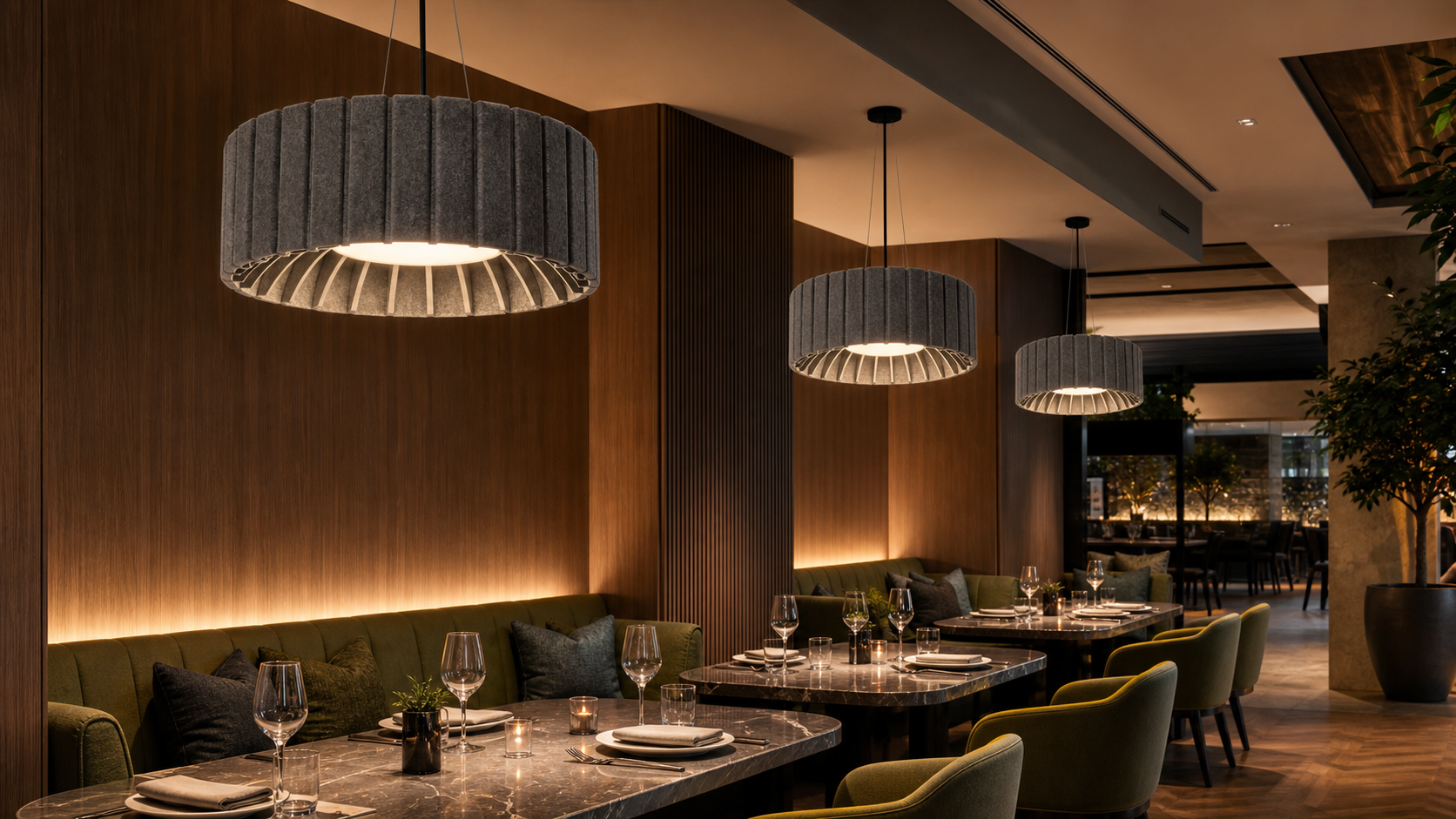
Acoustic lighting can make a practical contribution where suspended fixtures add both light and sound-absorbing area above a boardroom table or collaboration zone. Its value still depends on coverage, mounting height, the rest of the room envelope and the chosen fixture’s tested acoustic data. It should be combined with suitable wall or ceiling treatments when the room assessment calls for them, rather than assumed to solve every reflection path.
Impact on Acoustic Lighting
For suppliers, AVIXA’s message raises the value of specification-ready evidence. Provide photometry, glare and control compatibility together with acoustic test method and results, suspension details, material composition, maintenance information and available EPD or HPD documentation. Make clear what the product data demonstrates and what must still be determined at room level.
For B2B buyers, allocate an explicit acoustic scope and request a handover record that includes the intended and measured room result alongside AV documentation. Coordinate acoustic consultant, architect, MEP and AV teams before ceiling services are fixed. That reduces late changes in which visually attractive fixtures or expensive electronics are expected to overcome a room that was never designed for clear speech.
Apply This Trend
Need acoustic lighting options for a current project?
Send drawings, room type, target quantity, PET felt color, CCT and dimming needs. FLOSEEK can recommend project-ready acoustic lighting options.