
Industry Source
Beyond Decibels: Why One Number Can't Describe a Building's Acoustics
Published: October 29, 2026
View original sourceNews Summary
Kaiterra published “Beyond Decibels: Why One Number Can't Describe a Building's Acoustics” on October 29, 2026. The workplace-environment technology provider argues that a decibel value records sound energy over a defined period, but does not by itself show the frequency content of that sound or the way it changes throughout the day. Its point is that rooms with comparable level readings may still be perceived differently by occupants.
The resource frames continuous sound data as a way to understand when a room becomes louder, how the pattern changes and which frequencies dominate, rather than depending on one spot reading taken during a quieter period. That is especially relevant to commercial interiors whose activity shifts between focused work, calls, meetings, collaboration, circulation and events.
This is Kaiterra's educational guidance, not an independent study, a product specification or proof of a specific project outcome. The source does not disclose a chosen monitoring device, measurement protocol, baseline, calibration, privacy certification, data handling, acoustic target, physical treatment scope or post-occupancy result. Those factors remain project-specific and need separate definition and verification.
- Kaiterra published “Beyond Decibels: Why One Number Can't Describe a Building's Acoustics” on October 29, 2026, arguing that a sound-level reading represents energy over a period rather than the full acoustic experience of a building.
- The resource says one number does not describe sound frequency content or how conditions vary over time, which helps explain why rooms with similar measured levels can be experienced differently.
- Kaiterra presents continuous sound data as a way to identify when a space becomes loud, how the condition changes and which frequencies dominate, rather than relying only on a quiet-period spot reading.
- The source is educational vendor content. It does not name a sensor model, measurement metric, calibration method, sample interval, privacy certification, retention policy, room-acoustic result, compliance outcome or return on investment.
FLOSEEK Interpretation
For FLOSEEK buyers, the useful first step is to connect sound data to the activities taking place in each zone. Define the room programme, occupancy pattern, speech-privacy and clarity needs, key noise sources, target users and the moments that create complaints; then establish a suitable baseline before selecting ceiling absorbers, acoustic luminaires, wall treatment, furniture or AV measures. A reading without this operating context is a weak brief for design or procurement.
If a project considers ongoing sound monitoring, treat privacy and governance as design requirements rather than assumptions. Specify what will be measured, who can access it, how it is retained, what occupants are told and the acceptance criteria for any intervention. Coordinate the resulting actions with the reflected-ceiling plan, including acoustic coverage, luminaire photometry and glare, HVAC noise, sprinklers, detectors, AV, power, data and maintenance access; verify the occupied result against the agreed brief.
Impact on Acoustic Lighting
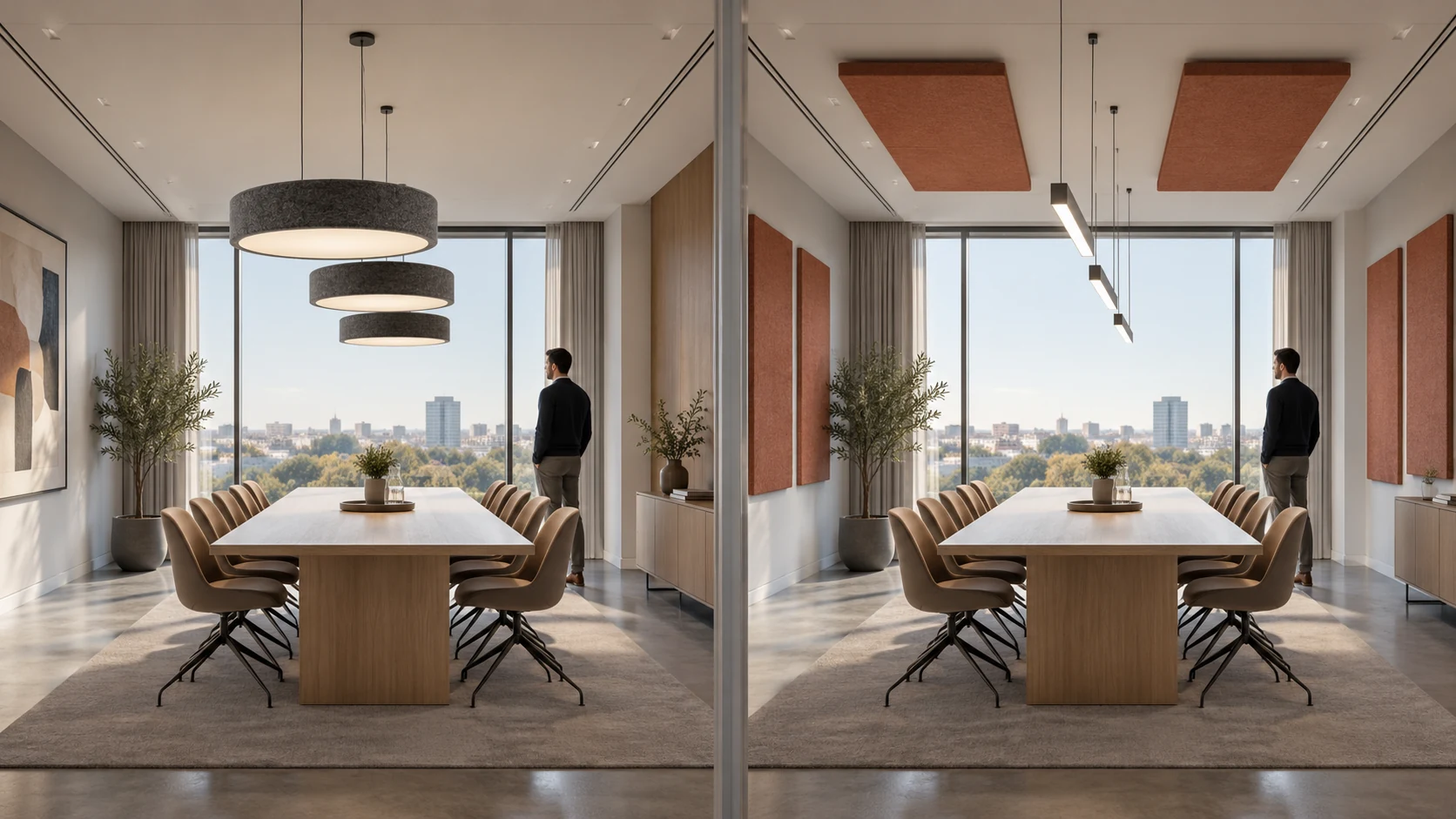
For acoustic-lighting and fit-out suppliers, the article reinforces the value of turning a broad comfort concern into an auditable scope. Submittals should distinguish monitoring information from verified architectural performance, identify the exact absorber and mounting configuration, and show coverage assumptions, test evidence, lighting calculations, controls, service interfaces and the measurement or commissioning boundary. Avoid implying that a sensor, a product or a single sound-level metric alone establishes acoustic quality.
For B2B project teams, assign ownership for the acoustic brief, baseline and post-occupancy review; privacy and data governance; lighting and acoustic calculations; ceiling coordination; mock-ups; commissioning; facilities training and handover. This gives workplace sound data a practical role in prioritising interventions while protecting speech comfort, visual quality, serviceability and trust in the finished commercial interior.
Apply This Trend
Need acoustic lighting options for a current project?
Send drawings, room type, target quantity, PET felt color, CCT and dimming needs. FLOSEEK can recommend project-ready acoustic lighting options.