Industry Source
Why acoustics can no longer be an afterthought
Published: October 1, 2026
View original sourceNews Summary
RIBA Journal published “Why acoustics can no longer be an afterthought” on October 1, 2026. The article, published in association with Oscar Acoustics, reports on a roundtable with architects, specifiers and workplace experts about why sound is often treated later than lighting, ventilation or accessibility. It argues for setting acoustic intent at the beginning of a project. This is supplier-associated editorial and event commentary, not an independent workplace trial, a product test or a new design standard.
The article relays findings that it attributes to new Oscar Acoustics research surveying 2,000 UK office workers. It says noise was the largest reported barrier to productivity among the issues respondents were asked about and that nearly two thirds struggle to concentrate on a typical day. It also says most surveyed employers had taken no meaningful acoustic action in the prior two years. The published article does not include the survey instrument, fieldwork timing, recruitment method, weighting, full dataset or independent peer review, so the figures should be read as supplier-reported survey signals rather than universal workplace benchmarks.
RIBA Journal also describes the roundtable's focus on designing for appropriate sound rather than attempting to eliminate sound. It refers readers to Oscar Acoustics' Sownd Certification material, saying the framework was developed by Sownd Affects and independently tested by the University of Southampton's Institute of Sound and Vibration Research. The article does not publish an acoustic design calculation, room measurements, speech-privacy result, lighting analysis, project cost, programme, installed-product comparison or post-occupancy outcome.
- RIBA Journal published the article on October 1, 2026, reporting on an Oscar Acoustics roundtable held with architects, specifiers and workplace experts about treating acoustics as an early design issue.
- The article says Oscar Acoustics surveyed 2,000 UK office workers and found noise to be the largest reported productivity barrier among the topics respondents were asked about; it also says nearly two thirds reported difficulty concentrating on a typical day.
- The report says most employers surveyed had not taken meaningful action on their acoustic environment during the preceding two years. The article does not publish the questionnaire, sample selection, fieldwork dates, weighting, full results or an independent statistical analysis.
- It references Sownd Certification, which the article describes as an evidence-based audio-inclusivity framework developed by Sownd Affects and independently tested by the University of Southampton's Institute of Sound and Vibration Research. It does not provide a project-specific acoustic or lighting result.
FLOSEEK Interpretation
For FLOSEEK buyers, the actionable lesson is to make sound an explicit part of the early workplace brief, with named owners alongside interiors, lighting, mechanical and controls teams. Map each zone's activities, occupancy, conversation and concentration needs, sound sources and paths, privacy criteria, room geometry and finishes, ceiling and wall availability, HVAC and AV noise, daylight, visual-comfort targets, power, controls, access, cleaning and maintenance. This is a project-planning inference from the article, not proof that any one treatment will solve a workplace problem.
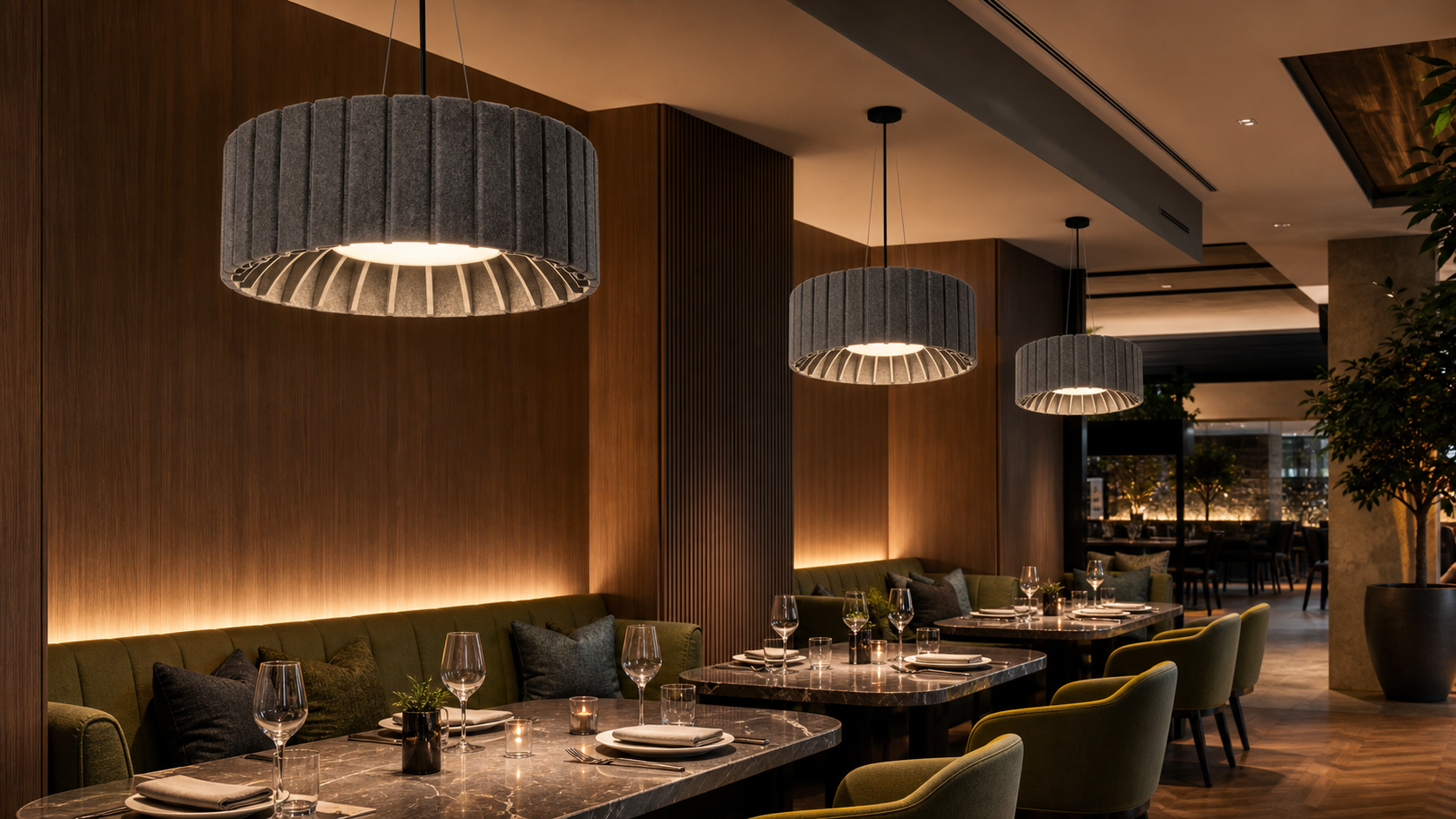
Acoustic lighting can contribute illumination and absorptive surface in a ceiling zone, but neither the article nor its reported survey evaluates an acoustic luminaire or establishes room-level productivity, wellbeing, speech, acoustic or lighting performance. Ask for configuration- and mounting-specific acoustic-test evidence, photometry and glare information, electrical and controls data, dimensions, loads, suspension, finishes, cleaning, service access and applicable compliance records. The responsible design team should calculate, coordinate and verify the actual room against its own criteria.
Impact on Acoustic Lighting
For suppliers, the report reinforces a familiar specification gap: broad workplace concerns need to become comparable, product-specific information. A submittal should state the tested acoustic configuration and mounting condition, coverage and positioning assumptions, photometry and glare data where applicable, controls and electrical needs, dimensions and loads, suspension and service interfaces, finishes, cleaning, maintenance and relevant compliance evidence. It should distinguish those documented attributes from predictions about an occupied room or workforce outcome.
For B2B project teams, turn an early-design intention into an evaluation workflow. Define zone uses, occupants and acoustic criteria; lighting and visual targets; daylight, ceiling, HVAC, sprinkler and AV constraints; available absorptive surfaces; controls and maintenance intent; programme, budget and acceptance method. Require bidders to identify what their acoustic-lighting and conventional-lighting documentation proves, what needs project-specific modelling or measurement, and who owns commissioning before award.
Apply This Trend
Need acoustic lighting options for a current project?
Send drawings, room type, target quantity, PET felt color, CCT and dimming needs. FLOSEEK can recommend project-ready acoustic lighting options.