Quick answer: is acoustic lighting worth it?
Acoustic lighting can be worth the cost when a project already needs new lighting and the verified acoustic contribution replaces enough separate treatment or coordination work. It is less likely to pay when good lights are already installed, the room needs far more absorption than the lighting layout can provide, or the complete fixture lacks credible acoustic and photometric data.
Think of a sofa bed. It may cost more than a sofa, yet less than buying a sofa and a separate bed. The saving exists only if it performs both jobs well and actually replaces both pieces. Acoustic lighting works the same way.
| Project condition | Likely direction | Why |
|---|---|---|
| New room needs lighting and added absorption | Often worth comparing | An integrated fixture may replace part of the separate lighting-and-panel package. |
| Existing lighting works well | Separate treatment often wins | Replacing a serviceable system adds electrical and removal costs that panels may avoid. |
| Acoustic demand is much larger than lighting demand | A mixed scheme is often strongest | Use enough luminaires for light, then close the acoustic gap with unlit treatment. |
| Ceiling space is crowded | Project-specific | One coordinated object may reduce clutter, but a larger fixture can also conflict with services. |
| Product evidence is incomplete | Do not pay the premium yet | A felt-sheet rating does not prove the performance of the complete suspended luminaire. |
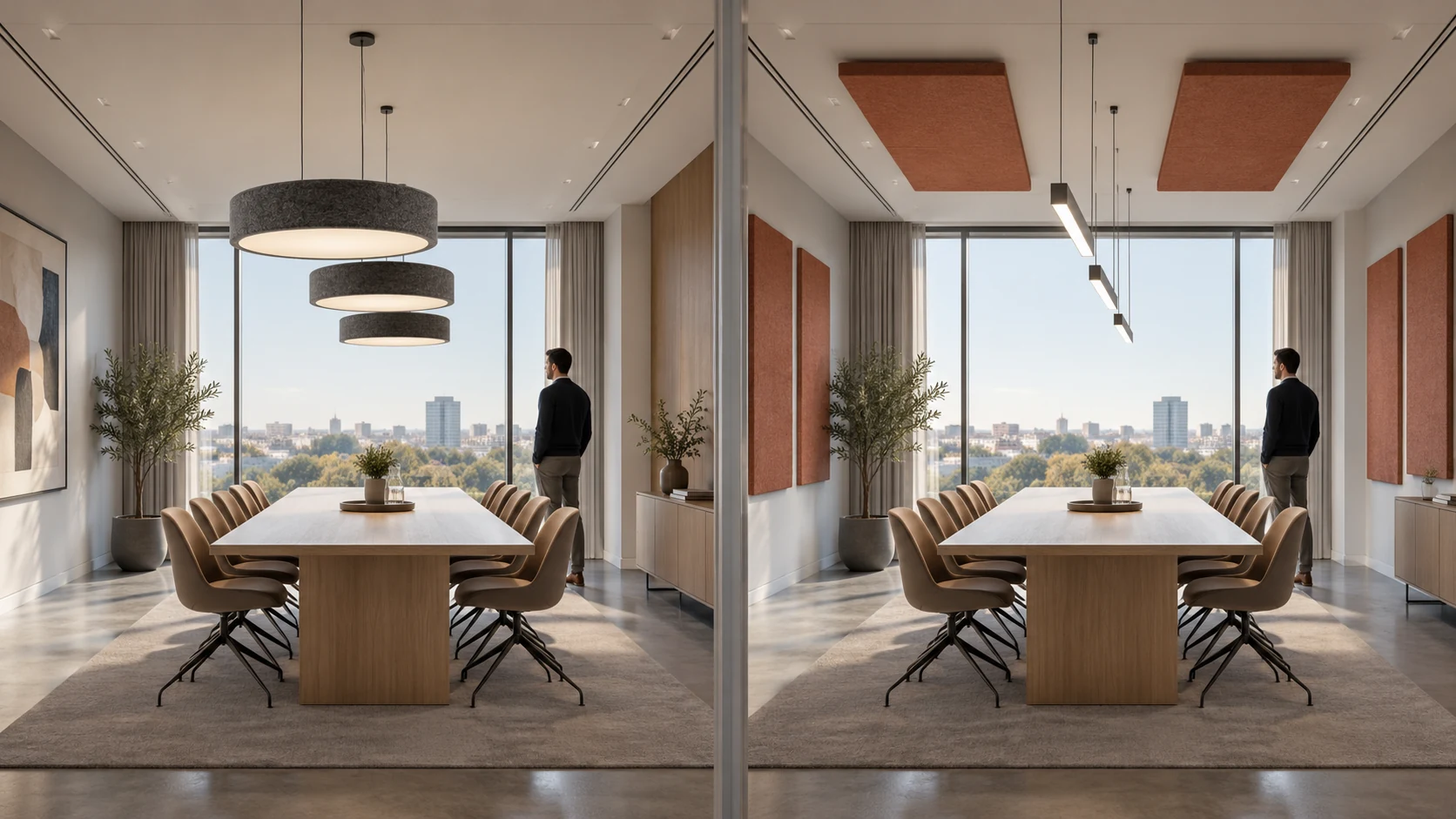
Compare two complete room schemes that meet the same lighting and acoustic brief. A price per pendant cannot settle a room-level decision.
What are you paying for?
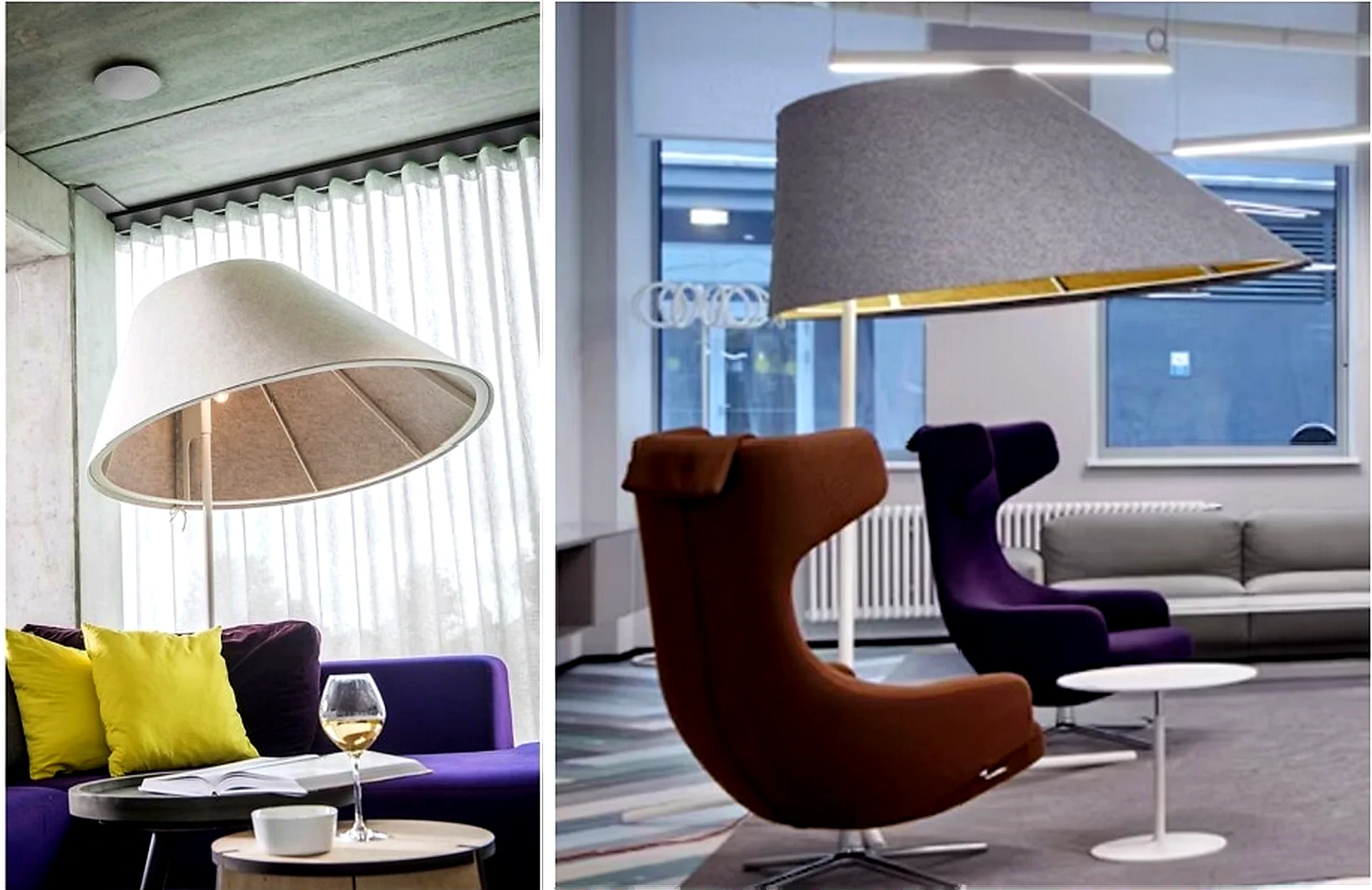
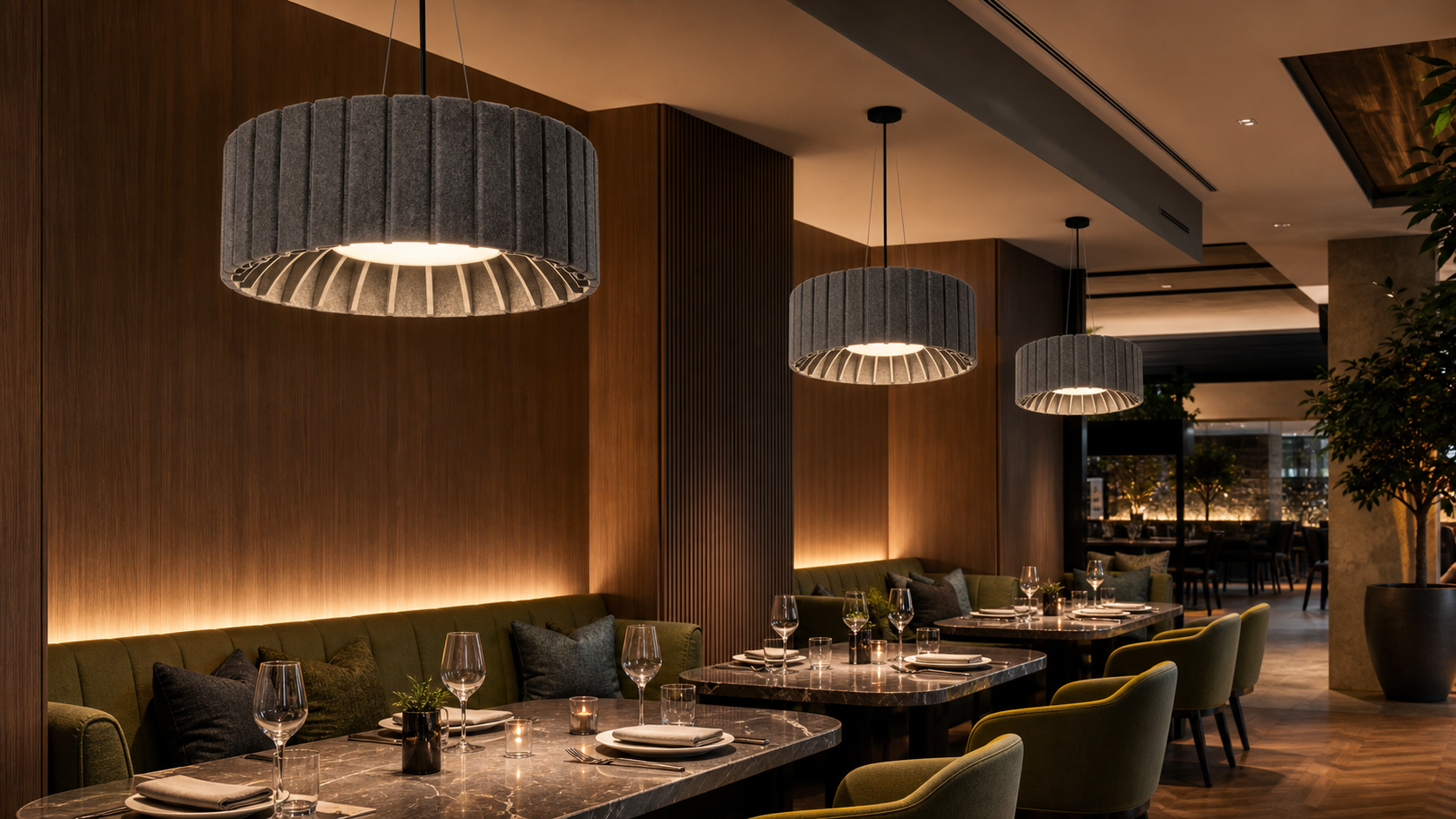
A standard pendant is bought mainly to light a surface. An acoustic pendant is bought to light the room and place absorptive material above it. That second job has value only when the complete fixture contributes useful absorption in the planned layout.
For a suspended object, ask for equivalent sound absorption area per complete fixture, ideally by frequency band and with the tested configuration. ISO 354 covers reverberation-room measurement; ISO 20189 addresses discrete interior objects. A rating for a flat PET felt sheet should not be pasted onto every finished pendant made from that sheet.
For the lighting job, compare the actual photometric file, output, mounting height, uniformity, glare and controls. An IES file is like a digital map of where the light goes; the Illuminating Engineering Society explains how designers use it for predictive calculations.
Until both jobs are checked, “two functions in one product” describes the idea. It does not prove that the room needs fewer products.
Compare two complete schemes, not two unit prices
Price the integrated and separate options against the same room, furniture, acoustic goal, lighting target, delivery term, site conditions and study period. Then test whether each design actually passes the brief.
Total project cost = products + delivery + installation + coordination + planned upkeep
A cheaper scheme that leaves the table dark or the room too reverberant is not a saving. Our PET felt acoustic lighting cost guide explains the price of a fixture and export quotation; this guide moves one level up to the total installed room.
The cost buckets buyers often miss
| Cost bucket | Integrated acoustic lighting | Separate lights and absorbers | Question to ask |
|---|---|---|---|
| Products | Acoustic luminaires, drivers and felt bodies | Standard luminaires plus panels, baffles or clouds | Are size, optics, controls and acoustic products all included? |
| Fixing and suspension | Canopies, cables and structural fixings | Lighting fixings plus a second set for acoustic products | Does the ceiling support every item in its final position? |
| Electrical work | Wiring, controls, addressing and commissioning | The same lighting work still applies | Has electrical work been counted once in both schemes? |
| Acoustic installation | The absorptive body arrives with the light | Panels or baffles need their own layout and labour | Is there genuinely less labour, or only fewer product names? |
| Ceiling coordination | One larger object to coordinate | More separate objects and fixing positions | Which layout creates fewer clashes with sprinklers, HVAC and access panels? |
| Freight and packing | Felt shades may need large protective cartons | Lights and absorbers may ship separately | Are both totals based on packed volume and the same delivery term? |
| Documents | Lighting, acoustic, material, fire-related and installation information | Lighting documents plus a separate acoustic submittal | Does every report match the exact quoted configuration? |
| Maintenance | Clean felt and service the light within one product | Lights and absorbers can be maintained independently | Can the driver be reached without damaging or removing the felt? |
One combined object does not magically halve labour. It still needs a safe fixing, power, controls and maintenance access. A large felt body can also need a stronger suspension or a larger carton. Ask the installer to define the scope before treating “one product” as “one simple operation.”
A transparent example: a new meeting room
Suppose a new meeting room needs twelve lights and additional mid-frequency absorption. The following USD amounts are invented only to demonstrate the method. They are not FLOSEEK prices, market averages, test results or a project quotation.
For the arithmetic, assume twelve complete acoustic pendants each contribute 0.8 m² of equivalent absorption area at one stated frequency band. Sixteen separately specified panels each contribute 0.6 m² in that same band and their tested mounting. Both routes total 9.6 m² in that band. This does not prove equal full-band performance, equal reverberation or equal lighting.
| Illustrative first-cost item | 12 acoustic pendants | 12 standard lights + 16 panels |
|---|---|---|
| Luminaires | 12 × $390 = $4,680 | 12 × $190 = $2,280 |
| Acoustic panels | Included in the assumed pendant design | 16 × $110 = $1,760 |
| Luminaire installation | 12 × $150 = $1,800 | 12 × $125 = $1,500 |
| Panel installation | — | 16 × $65 = $1,040 |
| Delivery and packing | $700 | $900 |
| Design and ceiling coordination | $350 | $350 |
| Illustrative installed total | $7,530 | $7,830 |
Under these assumptions, the integrated scheme is $300 lower at installation—about 3.8% of the separate scheme total. That is a narrow margin. A small change in product price, packing, labour or acoustic quantity can reverse the answer.
Find the break-even pendant price
Hold the other integrated costs fixed, subtract them from the separate scheme total, then divide what remains by twelve pendants:
[$7,830 − ($1,800 + $700 + $350)] ÷ 12 = $415 per pendant
At $415 per pendant, the two illustrative first-cost totals are equal. At $390, the integrated option is $300 lower. This is a threshold for this imaginary room—not a market price target or a FLOSEEK offer.
Before signing the order, confirm that twelve integrated fixtures deliver the specified light and that their acoustic evidence covers the complete product. If extra unlit panels are needed, add them to the integrated column.
The answer changes when good lighting already exists
Now assume the room already has suitable, serviceable lights and only needs absorption. Using the same invented assumptions:
- Keep the lights and add sixteen panels: $1,760 products + $1,040 installation + $550 delivery + $200 coordination = $3,550.
- Replace the lights with twelve acoustic pendants: $4,680 products + $1,800 installation + $700 delivery + $350 coordination + $500 assumed removal and disposal = $8,030.
The panel route is $4,480 lower in this example, before operating costs. Replacing useful lights needs another clear benefit: perhaps the project also requires a lighting redesign, a new interior concept or a ceiling where separate absorbers will not fit.
Adding felt around an existing luminaire is not a shortcut. The modified assembly still needs electrical, thermal, structural, fire-related and acoustic review.
When integrated acoustic lighting earns its premium
The project already needs new pendant lighting
The opportunity is strongest when lighting is already in the budget. Compare the premium over an otherwise suitable ordinary pendant with the separate panels and installation that the acoustic fixture can actually displace.
The lighting and acoustic layouts overlap
Meeting tables, workstation rows, restaurant seating and lounge zones often need both light and a useful place for suspended felt. The benefit weakens when the best acoustic treatment belongs on a wall or across a much larger ceiling area. Sound absorption does not form a tidy quiet circle below each pendant; it is more like adding sponges around a reflective room to soak up repeated echoes.
Use our acoustic pendant placement guide to coordinate suspension height, spacing, sightlines and service clearances.
The design values fewer visible elements
One carefully selected object can create a calmer ceiling than a light beside a separate cloud. That is real design value, especially in hospitality and client-facing rooms, but it is not automatically a cash saving. Put the expectation into the brief so both schemes are judged fairly.
Ceiling coordination favours one combined system
An integrated fixture may reduce separate absorber positions and drawing interfaces. It may also be a larger obstruction than a slim light and wall panel. Review actual dimensions, structure, cable positions, sprinklers, HVAC throw and maintenance access before assigning a saving.
When separate lights and panels are better value
The room already has good lighting
If illumination, glare and controls work, an acoustic-only retrofit may avoid new luminaires, electrical work and removal.
The acoustic requirement is much larger
A room may need eight luminaires but far more absorptive area than eight felt bodies provide. Adding more lights only for absorption can overlight the room. Larger unlit baffles, clouds or wall panels can close the gap more efficiently.
The two systems need different locations or replacement cycles
Separate treatment can follow the acoustic plan instead of the wiring grid, and each system can be serviced independently. Ask whether a driver or LED module can be replaced without disturbing a bespoke felt body.
The integrated product lacks evidence
Do not pay an acoustic premium for an unverified claim. Request data for the complete product and relevant configuration, or treat the acoustic contribution as zero in the comparison. Our NRC, αw and sabins guide explains what each number can—and cannot—tell you.
The mixed scheme is often the strongest answer
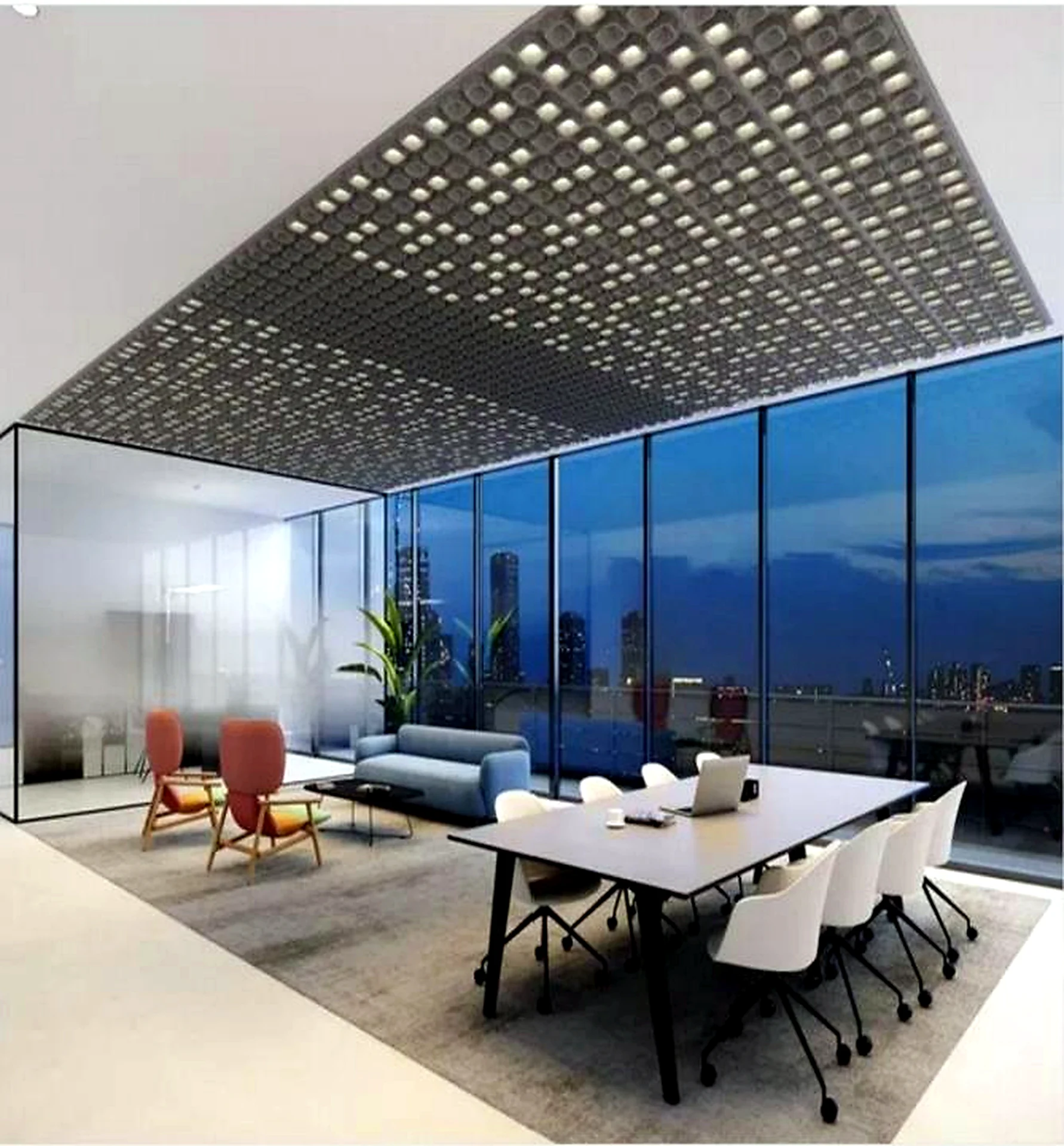
The choice is not limited to “all acoustic lights” or “all ordinary lights and panels.” A restaurant can place decorative acoustic pendants above fixed tables and use unlit treatment elsewhere. An office can combine acoustic linear lights over workstations with baffles between building services. A meeting room can use one central acoustic light and add wall absorption.
The mixed approach lets the lighting designer control how many light sources the room needs while the acoustic designer fills the remaining gap. It adds another product type to the schedule, so count that coordination honestly.
For a closer comparison, see Acoustic Lighting vs Acoustic Panels and Acoustic Baffles vs Ceiling Clouds vs Acoustic Pendant Lights.
Add operating cost and maintenance
The installed-cost examples are only the first page of the story. The U.S. Department of Energy's life-cycle cost guidance recommends considering costs such as purchase, energy, maintenance, repair, replacement and disposal when comparing energy-using products.
- Use the actual fixture wattage, control schedule, annual operating hours and local tariff.
- Define how often the felt and diffusers need cleaning and what access equipment is required.
- Check driver and LED service access, spare parts, replacement labour and warranty boundaries.
- Include future damage, reconfiguration and disposal under the same study period.
Do not claim energy savings just because one product performs two functions. Compare watts, delivered light and operating hours for the actual competing layouts. Also avoid turning better acoustics into a made-up dollar value for productivity or sales. If those outcomes matter, define how the project will measure them.
Five questions that can change the answer
- Does the room need new lighting? If not, compare acoustic-only treatment with replacement honestly.
- How much absorption is needed? Use the room target and complete-product data across relevant frequency bands.
- Do both schemes pass the light calculation? Compare task lighting, uniformity, visual comfort and controls—not watts alone.
- What is the real installed scope? Count freight volume, fixings, labour, access equipment and ceiling coordination.
- What happens after handover? Compare cleaning, repairs, spares and future layout changes.
If the first two answers are unknown, a confident saving percentage is premature.
What to send for a comparable quotation
| Input | Why it matters |
|---|---|
| Dimensioned floor plan and reflected ceiling plan | Establishes the room, ceiling services, fixing points and route to site. |
| Room use, furniture and occupancy | Defines work planes, visual goals and acoustic priorities. |
| Existing lighting and whether it will stay | Prevents a replacement scheme being compared with a reusable asset as if both start from zero. |
| Lighting target, CCT, glare and controls | Makes the photometric comparison meaningful. |
| Acoustic goal and existing finishes | Defines how much absorption to add and at which frequencies. |
| Preferred fixture and panel options | Keeps both schemes aligned with the design intent. |
| Installation height and service access | Affects labour, access equipment, maintenance and safe mounting. |
| Destination, shipping term and required documents | Aligns freight, tax treatment and technical submittals. |
| Comparison period and energy assumptions | Allows a consistent life-cycle cost calculation. |
Ask every bidder to state product quantity, test basis, lighting calculation, exclusions, freight and installation assumptions. An RFQ that asks only for pendant unit prices cannot answer whether acoustic lighting is worth the cost.
The decision in one sentence
Integrated acoustic lighting is worth its premium when its verified contribution to the room replaces enough separate treatment or coordination work to justify the added product and future service cost—while still meeting the lighting brief.
If the room already has good lights, needs much more absorption than the pendant layout supplies or calls for treatment in different places, a separate or mixed system can be better value.
FAQ
Are acoustic pendant lights always more expensive than regular pendants?
The individual acoustic fixture may cost more because it includes a felt body and related construction. The room-level result depends on the separate acoustic treatment, fixing and labour it can genuinely replace. Compare complete installed schemes, not pendant unit prices.
Can acoustic lighting eliminate wall or ceiling panels?
Sometimes, when the selected fixtures supply enough verified absorption for a modest target. Larger or more reflective rooms may still need additional treatment. Check the room calculation with frequency data for the exact fixture and mounting configuration.
Is one acoustic light equal to one acoustic panel?
There is no fixed one-to-one conversion. Compare tested equivalent absorption area at the same frequencies and consider mounting and placement. A panel's face area and a pendant's felt area are not directly interchangeable acoustic outputs.
Does an integrated fixture cut installation cost in half?
No. It still needs a safe fixing, electrical work, controls and maintenance access. Any saving comes from the specific separate products and site work that the integrated design can remove.
What if the integrated lights provide enough light but too little absorption?
Keep the luminaire quantity based on the lighting calculation, then add unlit acoustic treatment where needed. Adding bright fixtures only to gain more absorption can overlight the room and waste energy.
Should I compare factory price or installed cost?
Start with installed cost, which includes delivery, fixings, electrical work, acoustic installation and coordination. Then add energy, cleaning, access and replacement costs over the owner's chosen study period.
Can acoustic lighting improve the payback of an office renovation?
It can lower the combined cost in some layouts, but a payback claim needs a clear baseline, verified project costs and a measurable benefit. Do not assign a dollar value to productivity or wellbeing without project-specific evidence.
What should I send FLOSEEK for an accurate comparison?
Send the room plan, ceiling height, existing-lighting status, lighting specification, acoustic goal, preferred products, quantity, installation conditions, destination and required technical documents.
Compare the complete room—not just the pendant price.
Send the plan, ceiling height, existing-lighting status, acoustic goal, lighting specification, product preference, destination and budget range. FLOSEEK can prepare a focused acoustic-lighting option with the technical and quotation details needed for a fair comparison.
Related guides and product pages
- PET Felt Acoustic Lighting Cost: 2026 B2B Project Budget Guide
- Acoustic Lighting vs Acoustic Panels
- Acoustic Baffles vs Ceiling Clouds vs Acoustic Pendant Lights
- NRC, αw and Sabins Explained
- Acoustic Pendant Light Placement Guide
- LED Acoustic Pendant Light Specification Guide
- Acoustic Pendant Lights
- Acoustic Linear Lights
- Custom Acoustic Lighting Solutions


Build a fair room-level comparison
Turn the lighting brief, acoustic target and installation scope into one decision.
FLOSEEK supports commercial projects with acoustic lighting selection, custom PET felt structures, photometric information, available acoustic documentation, installation details and transparent quotation scope.