Quick answer: quieten the reflections, not the restaurant's personality
A lively restaurant has conversation, glassware and music. The trouble starts when the floor, glazing, ceiling and walls keep sending those sounds back into the room. People strain to hear, then speak louder; the next table does the same.
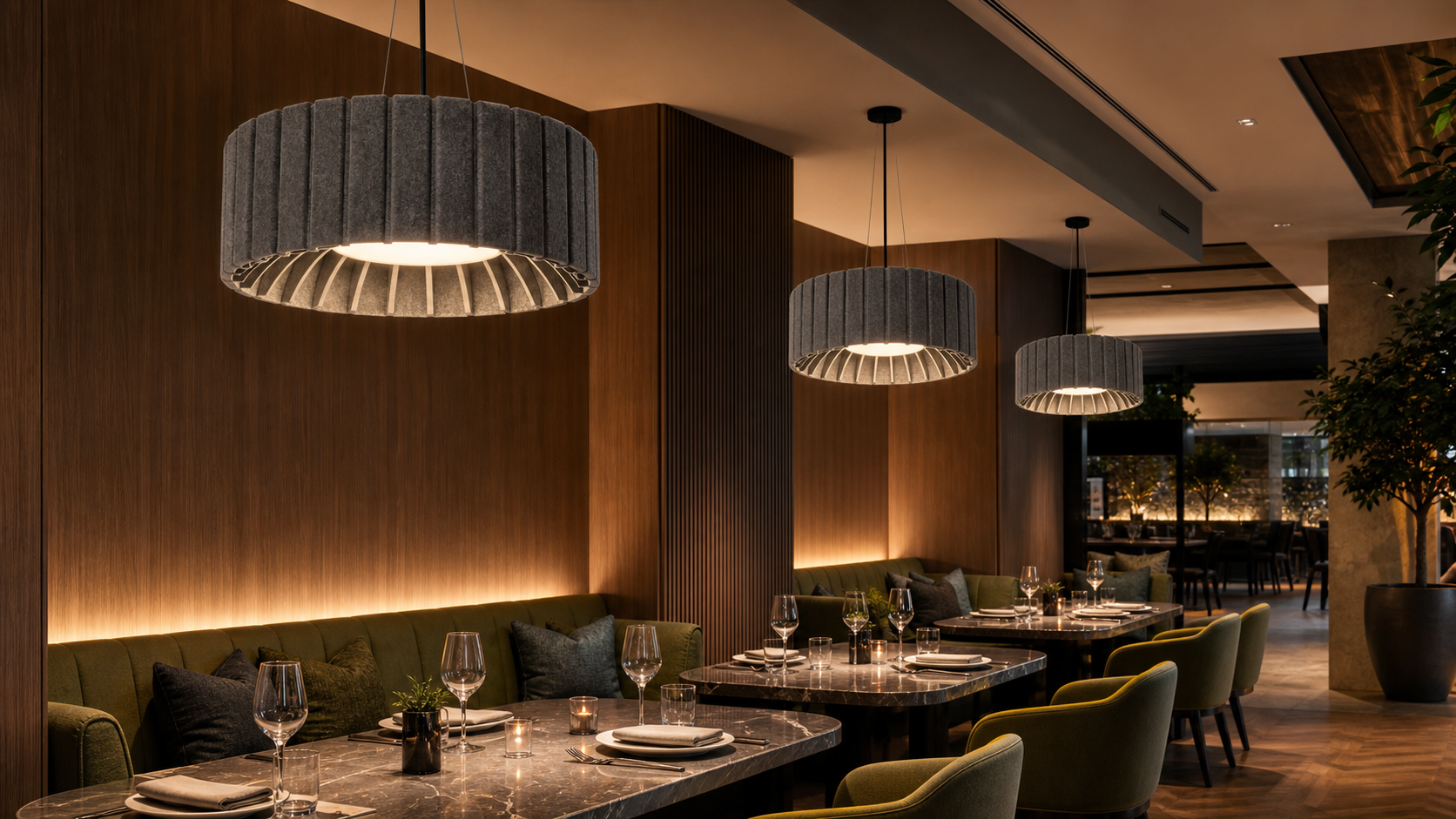
Acoustic pendant lights can help because they put absorptive material in a useful location—above tables, counters and seating. They work best as part of a plan, not as a decorative promise.
- Locate the hard surfaces and the seating zones where conversation becomes difficult.
- Separate reflection problems from music, kitchen, HVAC or sound-transmission problems.
- Calculate the added absorption from complete-fixture data—not from felt NRC alone.
- Distribute pendants through tables and conversation zones, rather than one decorative cluster.
- Keep the lighting layered, warm and dimmable; absorption and ambience are different jobs.
- Review cleaning, grease exposure, sprinklers, HVAC, structure and maintenance before ordering.
- Listen again during real service, then tune music, controls and furniture as needed.
The aim is not silence. It is to stop the room from fighting every conversation.
Why restaurants get loud so quickly
Voice, cutlery, chairs, coffee equipment, music, kitchen activity and HVAC may each be reasonable on their own. In a hard room, they pile up because sound keeps returning to diners.
Think of sound as a ping-pong ball. Soft, porous material catches part of the energy. Tile, glass, stone, painted plaster and exposed concrete send much more of it back. When nearly every surface is hard, the ball keeps bouncing.
This can create a feedback loop called the Lombard effect: as the background level rises, people naturally increase vocal effort. A restaurant study found that, in its simulated conditions, increasing noise raised vocal effort and reduced willingness to spend time and money. It is evidence of the direction of the problem—not a universal sound limit for every venue.
Echo, reverberation and soundproofing are different jobs
| What the team hears | What it usually means | First response |
|---|---|---|
| Distinct echo | A delayed reflection is heard separately | Treat the strong surface or long sound path |
| Excessive reverberation | Many reflections overlap and stay in the room | Add well-distributed absorption |
| Background-noise build-up | Voices, tableware, music and equipment combine | Control sources, zoning and reflections |
| Sound transmission | Noise passes to apartments or neighbouring rooms | Improve walls, ceilings, doors, services and isolation |
| Equipment noise | HVAC, refrigeration or kitchen equipment runs continuously | Source control, vibration isolation and maintenance |
PET felt acoustic pendants mainly address absorption inside the room. They do not automatically stop music, voices or bass travelling through the ceiling to an apartment above. That is like hanging towels in a room and expecting the wall to become thicker. For the full distinction, read Acoustic Lighting vs Soundproofing.
What acoustic pendant lights actually contribute
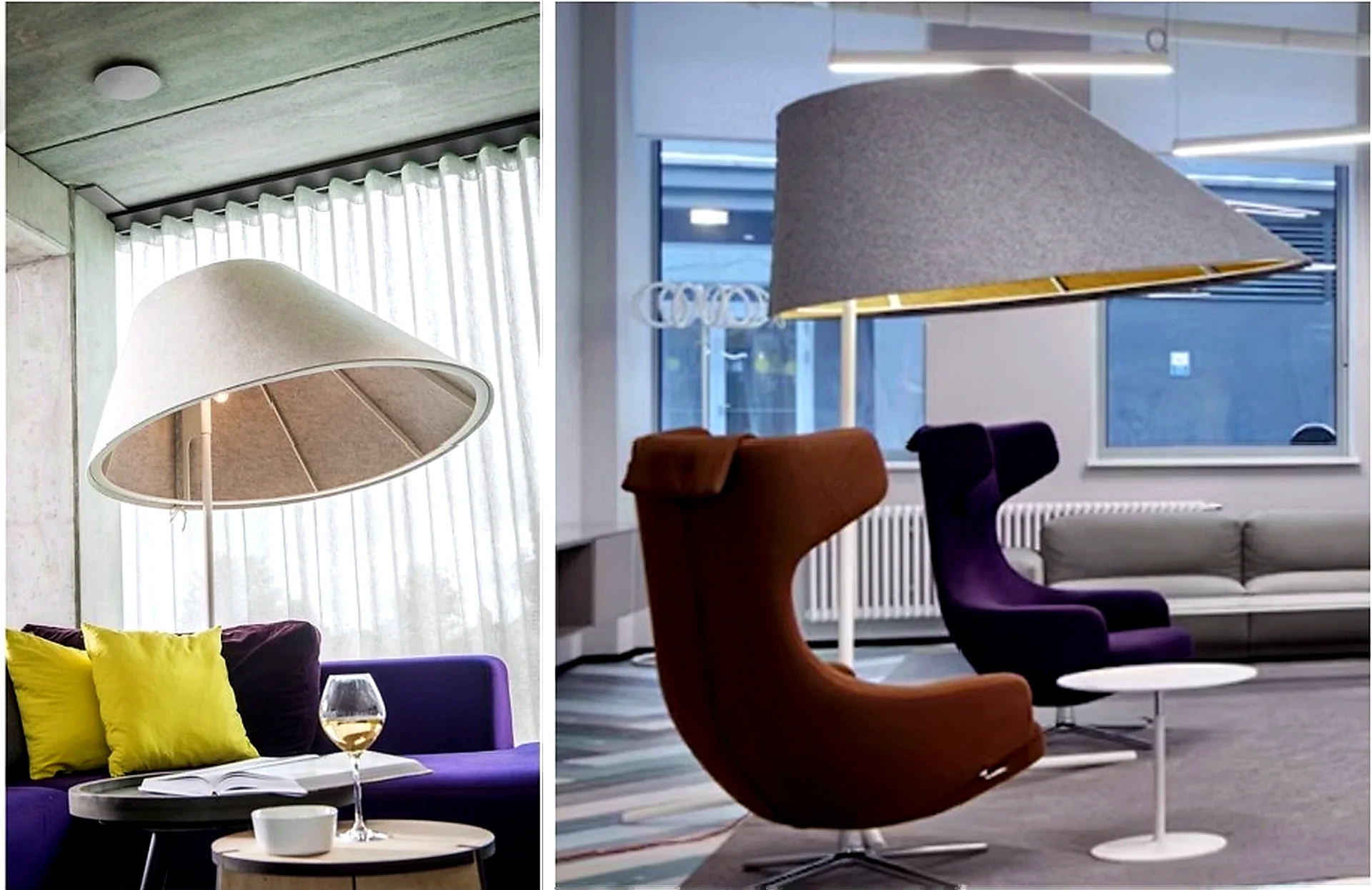
An acoustic pendant is a complete object: light engine, diffuser, driver, suspension, internal structure and exposed PET felt body. The felt slows part of the sound energy that reaches its fibres rather than reflecting it straight back.
Because a pendant is suspended, sound can reach its underside, upper surface, edges, folds and the spaces between fins. That makes it a useful design route where the project does not want a full wall of obvious panels. But a small felt ring and a large folded canopy do not provide the same contribution simply because both are made from PET felt.
Do not calculate a restaurant from felt NRC alone
A material statement such as “PET felt, NRC 0.85” may describe a flat tested system. It does not tell you what one finished pendant adds to the restaurant. Ask for the complete fixture's equivalent absorption area, frequency-band results, tested dimensions, felt construction, suspension arrangement and whether the supplied version matches the tested one.
The felt is like umbrella fabric: useful information, but not the answer to how much area the finished umbrella covers.
For discrete objects, ISO 354 covers equivalent absorption area measurement and ISO 20189 explains how single interior objects are assessed. Our NRC, αw and sabins guide translates the reports into practical buyer questions.
Start with restaurant zones, not a pendant catalogue
| Zone | Main concern | Practical direction |
|---|---|---|
| Main dining room | Overlapping conversations | Spread pendants or a mixed acoustic system across seating groups |
| Café seating | Speech, coffee equipment and hard finishes | Smaller pendants above seating groups; keep treatment outside steam-heavy positions |
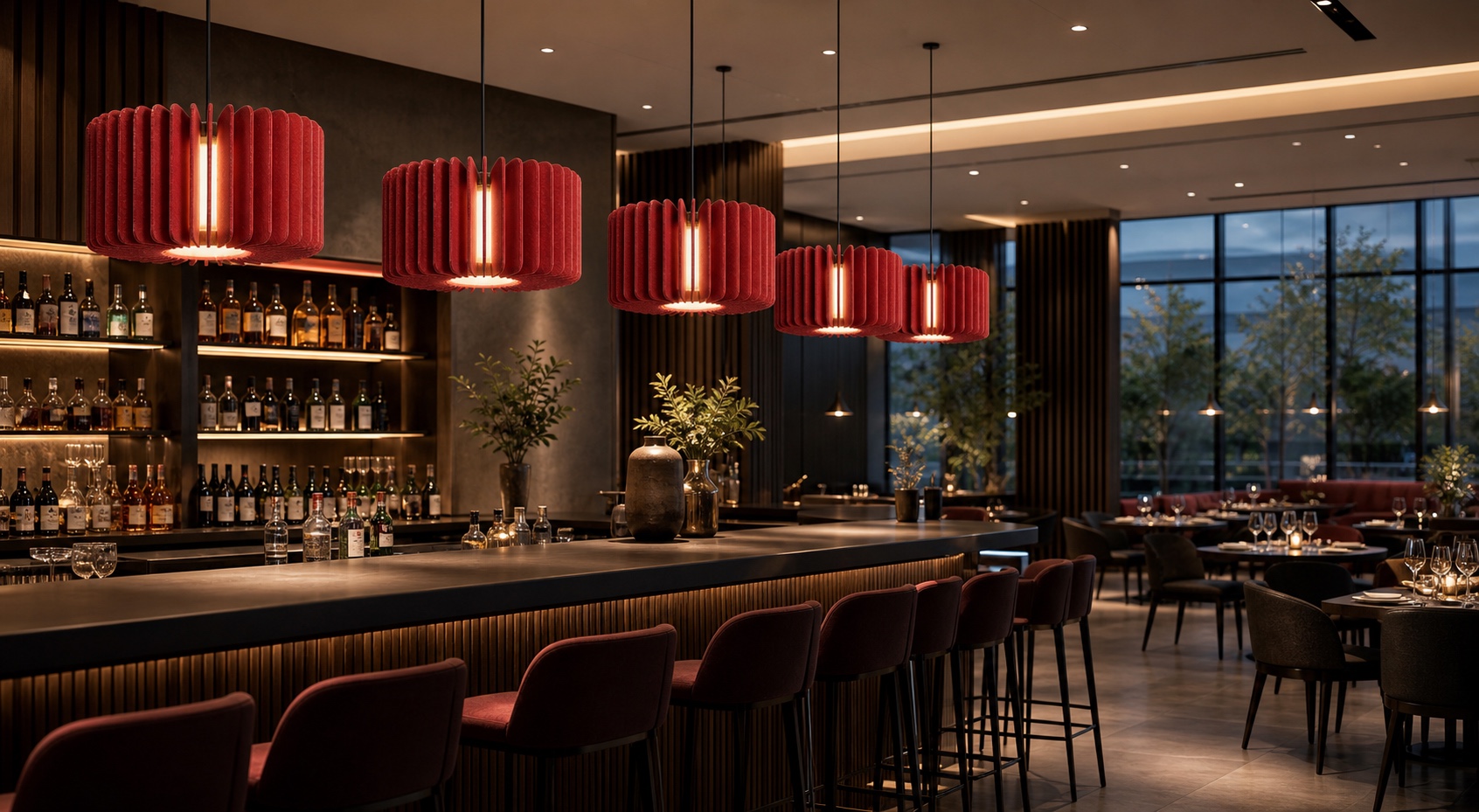
| Bar | Music, glassware and dense occupancy | Robust pendants plus ceiling absorption and source control |
| Private dining | Enclosed reflections and speech clarity | Local pendants with wall or ceiling treatment |
| Open-kitchen edge | Equipment and staff activity | Treat the dining side; control the source and avoid grease-heavy locations |
| Flexible banqueting | Movable tables and high occupancy | Higher grid or a mix of lit pendants and unlit baffles |
A feature cluster above reception or a bar can make a strong first impression. It will not automatically improve conversation at the far end of the dining room. Spread treatment through the places where people sit and talk.
How much absorption does a restaurant need?
There is no honest rule such as one pendant for every ten square metres. Two restaurants with the same floor area can behave very differently if one has curtains and upholstered booths while the other has tiled floors, full-height glazing and a double-height concrete ceiling.
For an early calculation, collect room dimensions and volume, finishes, glazing, soft furnishings, seat count, peak occupancy, open-kitchen and speaker positions, existing complaint or measured reverberation, target and complete-fixture absorption data.
The familiar early-stage relationship RT60 ≈ 0.161V / A can help frame the conversation, where V is room volume in cubic metres and A is total equivalent absorption area in metric sabins. It is not a final restaurant model: guests, furniture, irregular shape and uneven treatment matter.
When the acoustic quantity and lighting quantity disagree
Imagine the acoustic calculation calls for 20 m² of additional equivalent absorption and one tested pendant provides 1 m². Twenty fixtures are the first acoustic quantity. If the lighting plan only needs twelve luminaires, adding eight more full-output lights will likely overlight the room.
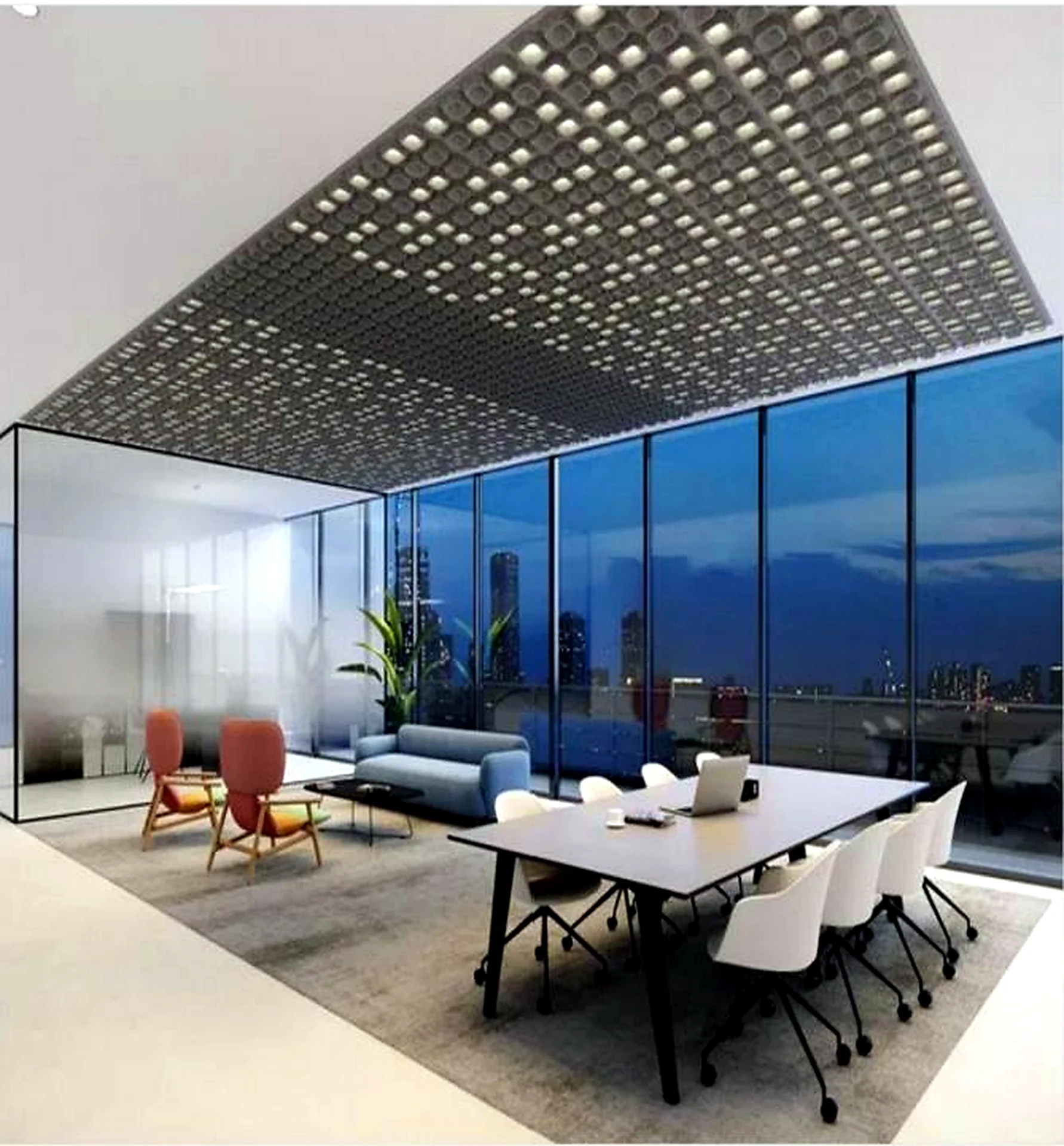
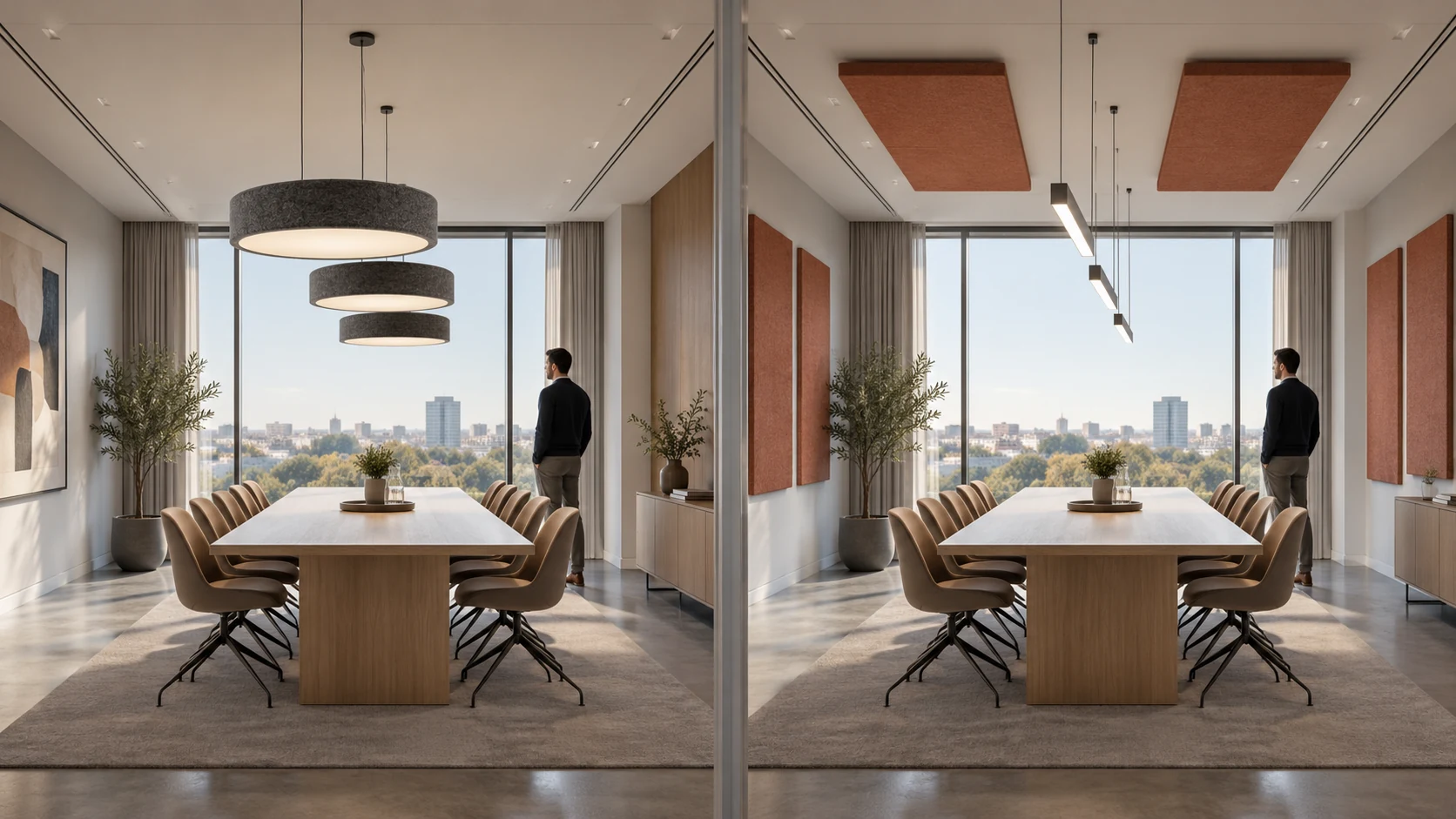
Better options include larger felt bodies around the twelve lights, low-output or separately dimmed added luminaires, unlit baffles, selected wall panels or ceiling treatment between light positions. Read Acoustic Lighting vs Acoustic Panels for the trade-offs.
Keep the atmosphere: warm light and absorption do different jobs
Felt does not need cool white light to absorb sound. The acoustic result comes primarily from structure, exposed area and installation. The mood comes from output, distribution, CCT, colour rendering, glare control, finishes and controls.
Do not use a low colour temperature as the entire definition of ambience. A 2700K table can still feel harsh if LED points are visible, the table is much brighter than the room or faces fall into shadow. A well-dimmed 3000K scheme can feel intimate when it balances table light, vertical brightness and indirect light.
Use layers: pendants over tables, wall washing for vertical brightness, accent light for displays, decorative light at the bar, service light where staff need it and properly coordinated emergency lighting. Like a good meal, one ingredient should not have to do every job.
Before approval, check delivered lumens, table and face illumination, CRI, seated glare, diffuser uniformity, dimming range, flicker, direct/indirect balance and colour samples under the intended CCT. The LED acoustic pendant specification guide covers this side in detail.
Placement, cleaning and ceiling coordination
Above fixed tables and booths
A pendant above a fixed table can usually hang lower because guests are not walking beneath it. Around 750–900 mm from tabletop to pendant bottom is a useful visual mock-up starting point—not a universal requirement. Raise it if it blocks faces, service, artwork or sightlines; if glare appears; or if the table may move. The pendant placement guide explains height, spacing and ceiling-service coordination.
Plan for the dirty reality of hospitality
Restaurant ceilings collect more than office dust. PET felt is porous, so ask about vacuuming, permitted brush or suction strength, stain handling, approved cleaning agents, replacement parts and access. Avoid assuming it belongs directly over grease-heavy cooking lines, steam or open flame.
Overlay every ceiling service before production
Coordinate sprinklers, HVAC diffusers, detectors, speakers, structure, drivers and maintenance access. A deep felt body can interfere with a service that looked clear on a simple reflected ceiling plan. The final fire, mechanical and electrical details belong with the responsible project consultants and locally adopted requirements.
A practical restaurant acoustic-lighting workflow
- Describe the complaint plainly: difficult conversation, general build-up, a strong reflection, equipment noise, music or neighbour complaints.
- Collect the plan, dimensions, finishes, ceiling height, seat count and photographs.
- Measure reverberation and background noise where a project needs evidence; listen in both quiet and service conditions.
- Set an objective that keeps the restaurant comfortable and lively rather than simply chasing the lowest possible RT60.
- Calculate added absorption with complete-fixture data, then compare that quantity with the lighting plan.
- Build the lighting scene around output, colour, glare, dimming and table use.
- Place treatment around diners, then coordinate maintenance, documentation and ceiling services.
- Approve a sample or mock-up, and review the finished venue during real service.
Restaurant mistakes worth avoiding
Calling every complaint “echo”
The real issue may be equipment, loudspeakers, vibration or sound transmission. Identify the source before buying treatment.
Buying from NRC alone
Material NRC does not say how much absorption one finished pendant provides. Request fixture-level data.
Putting every acoustic light above the bar
A beautiful acoustic island can leave the main dining area surrounded by hard surfaces.
Adding more lights when more absorption is needed
Use bigger felt bodies, dimming or unlit acoustic elements instead of overlighting the restaurant.
Ignoring grease and cleaning
A beautiful porous fixture can become a maintenance problem when it is placed in the wrong hospitality zone.
Judging the result in an empty room
A quiet empty dining room and a full Saturday night are different acoustic conditions. Tune the venue after real service.
FAQ
Do acoustic pendant lights really reduce restaurant noise?
They can reduce reflected sound and reverberation when enough tested absorption is installed in useful locations. They do not remove every noise source or replace sound-isolation construction.
Are restaurant echo and reverberation the same?
Not exactly. An echo is a distinct delayed reflection. Reverberation is the continuing build-up of many reflections. Most restaurant complaints called echo are closer to excessive reverberation and background-noise build-up.
How many acoustic pendant lights does a restaurant need?
Quantity depends on room volume, finishes, seating capacity, target and equivalent absorption area per complete fixture. A fixed number per square metre is not reliable.
Will acoustic treatment make a restaurant too quiet?
Not when it is designed for the venue. The aim is to control harsh reflections and help conversation, not remove the energy of a busy dining room.
Can PET felt pendants use warm white light?
Yes. Acoustic performance does not require cool white lighting. Warm CCT, high colour rendering, dimming and layered light can all be specified alongside the felt structure.
Can acoustic pendant lights stop noise reaching apartments above?
Not by themselves. They reduce reflections inside the restaurant. Noise reaching another occupancy may require work to the ceiling, walls, floor, services and vibration paths.
Need a preliminary restaurant acoustic-lighting review?
Send the restaurant plan, ceiling height, seat count, finishes, lighting brief, current acoustic complaint and known sprinkler/HVAC positions. We can help compare pendant structures, preliminary layouts, lighting specifications and relevant documentation.
Related reading and product pages
- Restaurant and Hospitality Acoustic Lighting Applications
- Acoustic Pendant Light Placement Guide
- NRC, αw and Sabins Explained for Acoustic Lighting Buyers
- Does Acoustic Lighting Really Work?
- Acoustic Lighting vs Soundproofing
- Acoustic Lighting vs Acoustic Panels
- PET Felt Acoustic Material Lighting Guide
- Acoustic Pendant Lights
- Custom Acoustic Lighting Solutions

Make conversation easier
Planning acoustic lighting for a restaurant, café or hotel dining room?
Share the room type, seating layout, ceiling height, lighting intent, current complaint and target market. We can help identify a practical pendant structure and the information needed for the next design review.